What a crease pattern contains
Every crease pattern represents the sheet in its flat, pre-folded state. Mountain folds push material upward toward the viewer; valley folds push it away. When the sheet is fully collapsed, all creases must simultaneously satisfy the flat-fold conditions — the paper cannot interpenetrate itself and no material is added or removed.
The most immediate visual cue is the ratio of mountain to valley folds meeting at a single interior vertex. Kawasaki's theorem states that, at any flat-foldable vertex, the alternating angle sums around it must each equal 180°. Maekawa's theorem adds that the difference between the number of mountain and valley folds at any flat-foldable vertex is always exactly two.
The Huzita–Hatori axioms
In the 1980s, Humiaki Huzita formalised origami geometry as a set of fold operations on the Euclidean plane. The original six axioms were later completed by Koshiro Hatori, who identified a seventh. Together they define the full set of single-fold operations that can align combinations of points and lines:
- Fold a point onto another point.
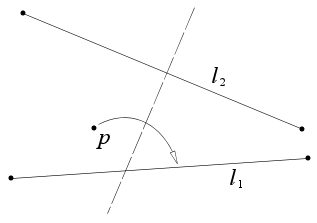
- Fold a line onto another line.
- Fold a point onto a line.
- Fold a line perpendicular to another line through a given point.
- Fold a point onto a line with the fold also passing through a second point.
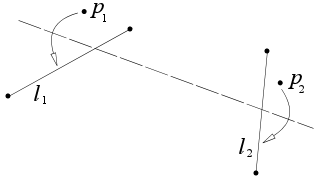
- Fold a point onto a line while simultaneously folding a second point onto a second line (Beloch fold).
- Fold a line onto itself through a given point (Hatori's axiom).
Axiom 6, the Beloch fold, is particularly significant: it solves the general cubic equation geometrically, making origami strictly more powerful than compass-and-straightedge construction, which is limited to quadratics.
Flat-foldability and layer ordering
A crease pattern that satisfies Kawasaki's and Maekawa's theorems at every interior vertex is locally flat-foldable. Global flat-foldability — ensuring the entire sheet collapses without self-intersection — is a harder problem and has been shown to be NP-complete in the general case (Bern and Hayes, 1996).
Layer ordering is the combinatorial record of which paper layers lie above which others when the model is fully flattened. For complex models with many vertices, the number of valid layer orderings can be very large, and not all are physically realisable with a single connected sheet.
Reading a published crease pattern
Most published crease patterns use the Yoshizawa–Randlett notation: solid lines for mountains, dashed for valleys, and dot-dash for fold-and-unfold or reference creases. Reference creases are temporary alignment aids folded and then opened; they do not appear in the finished model but are essential for locating proportional division points on the sheet.
Robert J. Lang, Origami Design Secrets (A K Peters, 2003) — chapter on crease patterns and flat-foldability.
Marshall Bern and Barry Hayes, "The Complexity of Flat Origami", Proceedings of the 7th Annual ACM-SIAM Symposium on Discrete Algorithms, 1996.
Wikipedia: Huzita–Hatori axioms.
Crease diagrams in Polish origami practice
The Polish Origami Association (Polskie Towarzystwo Origami), active since the early 1990s, has organised conventions at which crease pattern interpretation workshops have featured. Practitioners working in Warsaw and Kraków have noted the influence of Robert Lang's TreeMaker algorithm on designs submitted to the association's annual meeting — particularly for insect models where precise leg proportions require computational crease layout.
Paper choice affects crease sharpness. Thin, sizing-free papers such as uncoated Japanese washi allow valley folds to fully collapse without fibre separation. Commercially available A4 office paper, widely used in Poland for beginner models, has a heavier basis weight that produces visible fibre stress at tight mountain folds.