Structure of the waterbomb base
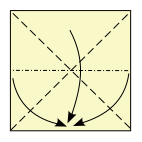
Starting from a square sheet, four diagonal folds and two midpoint folds produce the waterbomb base. The central vertex carries six crease lines: four diagonals meeting at 45° and two axis folds at 90°. The resulting configuration satisfies Maekawa's theorem (four valley folds, two mountain folds — a difference of two) and Kawasaki's theorem (alternating angle sums of 90° + 90° = 180° at every adjacent pair).
When the base is inflated — air blown into the open end — the sheet forms a cube-like balloon, the traditional suisen or waterbomb. The inflatability arises from the geometry: the four triangular flaps swing outward uniformly, converting the flat crease pattern into a stable three-dimensional shell.

Pleating: accordion and box pleats
A pleat is a paired fold: one mountain and one valley running parallel, compressing the sheet into a layered band. The simplest repetition is the accordion pleat, which alternates mountain and valley folds at equal intervals. Accordion pleating is the basis for paper fan forms and the starting grid for many flat-fold tessellations.
Box pleating uses a grid of horizontal and vertical pleat lines, typically at 22.5° subdivisions (a full 90° angle divided by four). This subdivision allows diagonal folds at 45° to connect grid intersections, giving the folder access to a large set of proportional lengths from a single square. Box pleating is the structural language behind many of Robert Lang's insect and arachnid models.
Sink folds and inside reverse folds
A sink fold inverts the tip of a point inward without separating the layers. It requires all crease lines radiating from the tip to be partially open simultaneously — a multi-layer manoeuvre that is easier to describe geometrically than to execute on thick paper. The sink fold appears frequently in bases that need a short, squared-off point rather than a sharp tip.
An inside reverse fold pivots one flap inward along a new crease. The classic crane tail-pull — spreading the wings — uses a series of outside reverse folds. In terms of crease geometry, both operations introduce a new crease line crossing existing ones; the angle and position of the new crease determine the final proportions of the reversed flap.
Radial pleating and twist folds
Radial pleating arranges pleat lines around a central point rather than in parallel rows. A twist fold combines a rotation with a pleat: the central region of a sheet spins relative to the surrounding material, producing a pinwheel-like flat form. Twist folds are the repeating unit in many origami tessellations, including the work of Eric Gjerde and Paul Jackson, whose published diagrams have been widely circulated at European folding conventions.
Paul Jackson, Folding Techniques for Designers (Laurence King, 2011) — comprehensive treatment of pleat types including accordion, box, and radial pleats.
Eric Gjerde, Origami Tessellations (A K Peters, 2008) — practical guide to twist folds and grid construction.
Wikipedia: Origami — Techniques section.
Pleating in Polish paper folding practice
Accordion and box pleating have appeared in workshop programmes at the annual Polska Noc Origami events. Participants working with standard 80g/m² office paper — the most commonly available square in Poland outside specialist suppliers — find that box pleating grids tighter than 1/16 divisions require dampening the paper to prevent fibre splitting along the parallel mountain folds. Washi and Italian Fabriano papers, obtainable from art supply shops in Warsaw's Śródmieście district, perform better at fine subdivisions.
The Miura-ori pattern, developed by astrophysicist Koryo Miura in the 1970s and now used in deployable satellite panels, is a tessellation built from parallelogram-shaped pleating units. Its rigid-foldability — the ability to flatten and expand without bending the individual panels — makes it a recurring subject in engineering-adjacent origami discussions in Polish academic settings.